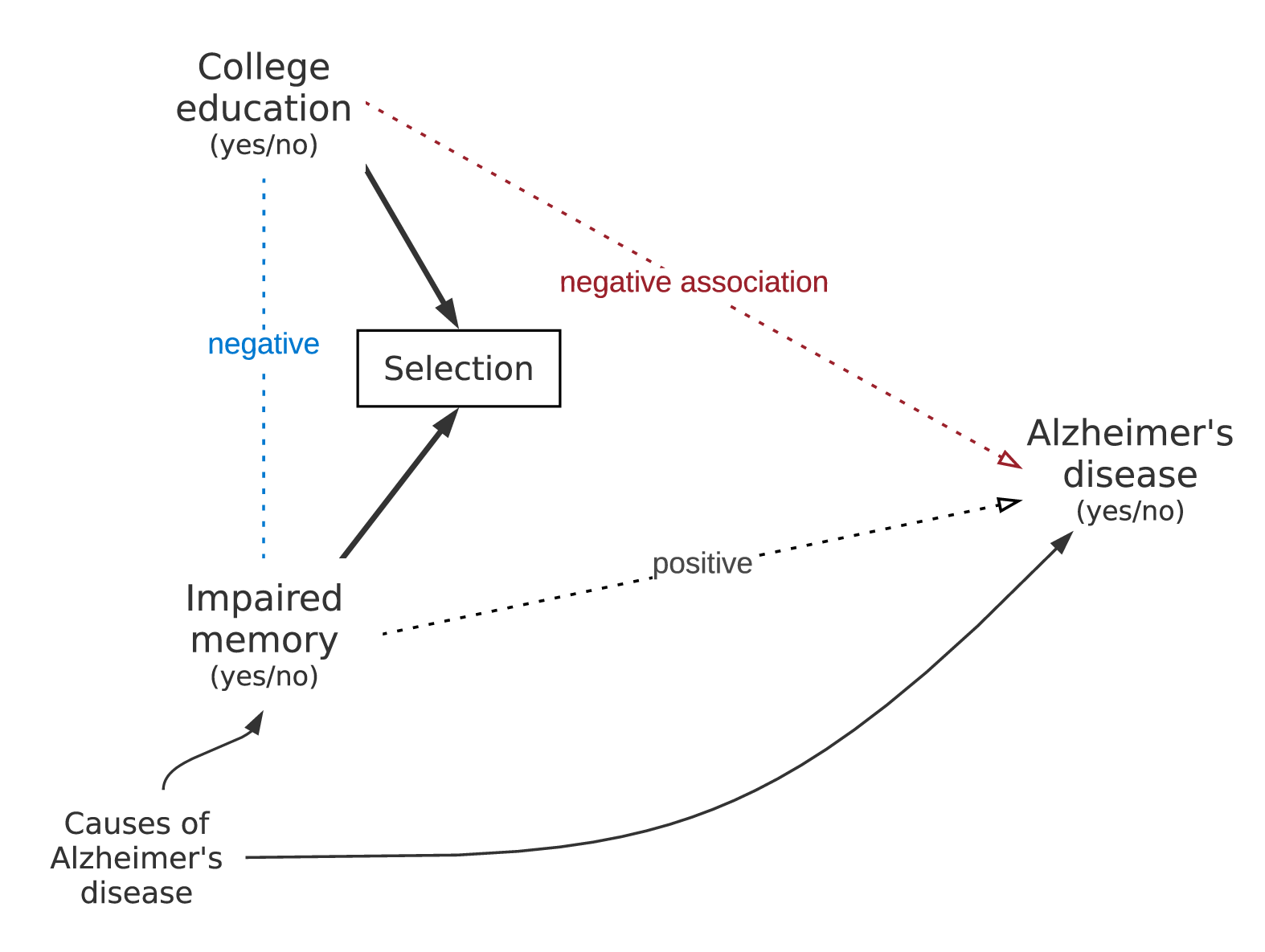
This is an example of selection bias, a form of collider bias, that is adapted from Figure 12.5 in Modern Epidemiology (2008) by Rothman, Greenland, and Lash.
In this extreme example, the research question ‘does college education lower the chance of Alzheimer’s disease’ was examined by analysing a dataset pooled from two separate studies, with participants either:
- college-educated people (with or without impaired memory), or
- people diagnosed with impaired memory (with or without a college education)
However, this produced a dataset where every person without a college education happened to have impaired memory, while those without impaired memory had all been to college. Hence, a negative association existed in the data between having a college education and having impaired memory (but not necessarily causal, hence the blue dotted line representing an association).
But impaired memory is often an early symptom of Alzheimer’s disease where, in many cases, the causes of impaired memory go on to cause diagnosable Alzheimer’s disease. Thus, an association would also have existed between impaired memory and Alzheimer’s disease, as represented by the black dotted line arrow. Though, in this case, the association existed because of confounding from a common cause.
Note that a dotted line arrow is used here instead of just a dotted line, to represent an association in the data between a variable occurring earlier in time and a variable measured later. The arrow suggests the direction of a causal effect that a researcher might mistakenly infer from a spurious association.
Thus, in this hypothetical study, college education would be negatively associated with Alzheimer’s disease, but instead of suggesting a causal effect, the association is more likely to have resulted from the method used to select participants. That is, not from any protective effect that gaining a college education might have on the chance of developing Alzheimer’s disease (this is only a made-up example, however).
Reference
Rothman KJ, Greenland S, Lash TL. Modern Epidemiology. 3rd ed. Philadelphia, PA: Lippincott, Williams & Wilkins; 2008.